REVIEW · SIEM REAP
Battambang, Bamboo Train, Killing Cave Day Tour From Siem Reap
Book on Viator →Operated by About Cambodia Travel & Tours · Bookable on Viator
Battambang is a great antidote to Angkor-day overload. This full-day trip takes you from French-colonial streets to rice-field countryside, then ends with sunset bats and a sobering Khmer Rouge stop. It’s one of those days where the scenery changes often, so the time in transit doesn’t feel wasted.
I really like two things about it. First, the bamboo train ride is an easy, fun highlight that actually feels local—open-air, slow enough to watch villages and rice fields go by. Second, the day blends upbeat sights with serious history, from temple viewpoints to the Killing Cave.
The main thing to consider is that it’s a long day (8 to 10 hours). You’ll want comfortable shoes and a flexible mindset, especially when the itinerary turns toward the darker sites.
In This Review
- Key Things You Should Expect
- Battambang in One Long Day: Why This Route Works
- Road Trip Comfort and a Real Private Setup
- Walking Battambang: French Colonial Charm by Steung Sangké River
- The Bamboo Train: Classic Rural Rail, Not a Tourist Trap
- Royal Bungalow, White Elephant Pagoda, and the Central Market Stop
- Phnom Banan: A Hilltop Temple Built for Panoramas
- Phnom Sampov and Pkar Slar Cave: Temple Wells and Cave Atmosphere
- The Killing Cave Stop at Phnom Sampeau: When the Day Turns Heavy
- Battambang Bat Caves at Sunset: Why the Timing Matters
- Price and What You Actually Get for $166.25
- What I’d Pack and How to Pace Yourself
- Who This Tour Suits Best (and Who Might Skip It)
- Should You Book This Battambang Day Tour?
- FAQ
- How long is the Battambang bamboo train and caves day tour?
- Do you get hotel pickup and drop-off?
- Is this tour private or shared?
- Is lunch included in the tour price?
- What is included in the tour price ($166.25 per person)?
- Is the Cambodia Peace Gallery ticket included?
- What days is the Cambodia Peace Gallery open?
- Are entrance fees included for the temples and caves?
- Is there free cancellation?
- Is the tour suitable for most people?
Key Things You Should Expect
- A private, guided day with hotel pickup and drop-off in an air-con vehicle
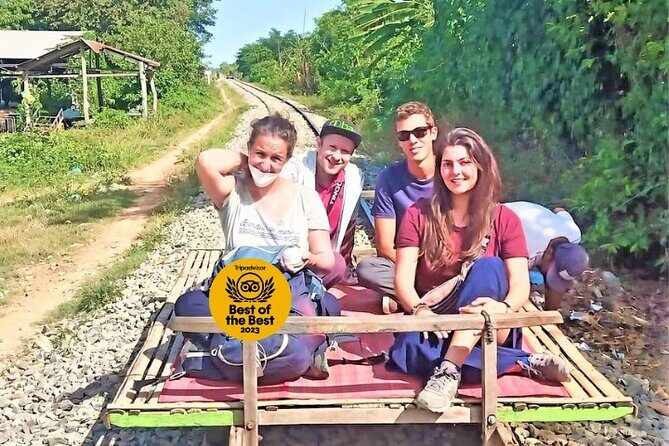
- Bamboo Train from O Dambong to O Sra Lav for a classic rural rail experience
- Hilltop temple views at Phnom Banan and Phnom Sampov (including pagodas and wells)
- Serious historical contrast with Pkar Slar Cave and the Killing Cave at Phnom Sampeau
- Sunset timing for Battambang Bat Caves (short stop, big payoff)
Battambang in One Long Day: Why This Route Works
Battambang is Cambodia’s second-largest city, and it’s known for more than just being a stop on the way somewhere else. The feel here is calmer than Siem Reap, and the mix is smart for a day trip: colonial-era downtown moments, real countryside travel via the bamboo train, then hilltop temples and caves.
What I like about this itinerary is the pacing. You get a “city and architecture” start, then you move into the countryside. After that, the day climbs up and down hills, with short, specific stops that keep you from feeling like you’re watching the guide’s PowerPoint on the move.
The day also gives you options for what kind of mood you want. If you’re temple-first, Phnom Banan and Phnom Sampov deliver the views. If you want reflection, the Khmer Rouge sites are built into the flow so you’re not scrambling to add them later.
You can also read our reviews of more tours and experiences in Siem Reap.
Road Trip Comfort and a Real Private Setup
This is a private tour for your group, with pickup and drop-off at your hotel. You travel by luxury air-con vehicle, which matters on a long day—especially when Battambang day trips can feel like a full reset of your energy.
The driver and guide pair is part of what makes this kind of day manageable. In the experience I’m basing this on, guides such as Leap and Sara paired well with drivers like Samart, Lan, Art, and Pheap—with people pointing out that the service felt smooth, attentive, and comfortable. There’s also a theme of taking time for photos. You’re not just herded from one wall to the next.
Another practical plus: entrance fees for most stops are included, so you’re not constantly guessing what costs extra at each site.
One realistic consideration: lunch isn’t included. That’s normal for Cambodia day tours, but it means you’ll want to plan for a sit-down meal somewhere between the heavier stops.
Walking Battambang: French Colonial Charm by Steung Sangké River
The first stop is Battambang city itself, where the tour uses the downtown area to set the tone. This city is tied to Cambodia’s broader story—founded in the 11th century, and historically linked to the Monton Khmer region—yet today you experience it through streets, buildings, and river life.
You’ll spend about an hour in the city area, with the focus on French colonial architecture along the Steung Sangké River. This is the kind of walking that pays off because it’s not just one landmark. You get to see the layout of the town and how the river fits into daily life.
Then the itinerary adds a few “architecture-and-culture” anchors:
- Royal Bungalow at the provincial residence compound (built in the 1960s by architect Vann Molyvann, mixing traditional Khmer and colonial-era design ideas)
- Damrey Sor Pagoda, also called the White Elephant Pagoda, in the busy city-center district
- Battambang Central Market, an easy place to browse and feel the rhythm of the province (and it’s also described as a draw for its preserved colonial look and creative scene)
If you like cities where you can slow down and look up at facades, this opening block is your reward.
The Bamboo Train: Classic Rural Rail, Not a Tourist Trap
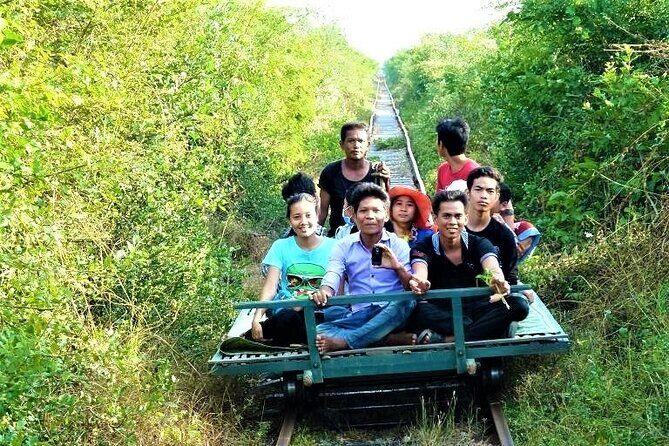
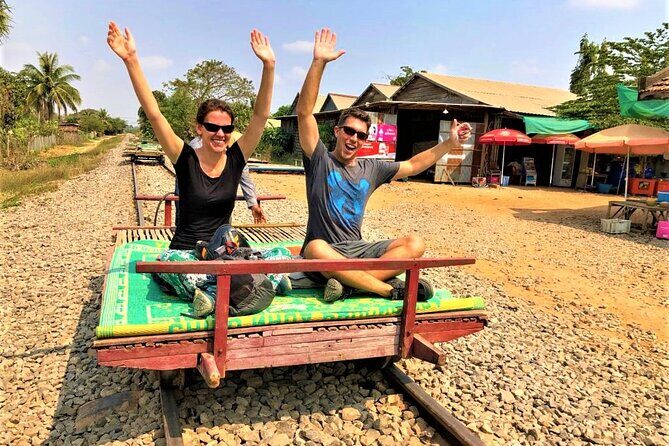
The bamboo train is the headline, and for good reason. It runs from O Dambong (on the east bank, about 3.7 km south of Battambang’s Old Stone Bridge) to O Sra Lav, and you’re on it for about an hour in the schedule.
The best part is that it doesn’t try to be a theme park. It’s an open-air ride where you can see rice fields, local villages, and the countryside rhythm roll past. It’s fun because you’re moving through real places, not just around a staged attraction.
Practical tip: bring something to protect your face and eyes from dust if the day is dry. And if you’re the type who likes photos, this is one of the better moments of the day to ask your guide for timing and viewpoints—people on this tour’s day experiences specifically mention getting help with cool photo spots and picture-taking.
Also, don’t mentally lump the bamboo train into the “quick ride” category. It’s short enough to fit a day trip, but it’s long enough to feel like a proper experience.
Royal Bungalow, White Elephant Pagoda, and the Central Market Stop
After the bamboo train, you go back into town for more compact but worthwhile stops. Here’s what they’re adding to your day beyond a quick checklist:
Royal Bungalow (about 45 minutes)
This one is about architecture and historical style. It’s described as a fusion of traditional Khmer design with colonial influences. If you enjoy seeing how Cambodian architects adapt and blend influences across decades, this stop gives you a satisfying “how things were built” moment without needing a museum ticket.
Damrey Sor Pagoda, White Elephant Pagoda (about 45 minutes)
This is a temple in the city center, in a busy district. That’s a plus: you see religion as part of everyday streets, not only as a remote destination. The guide can help you read what you’re seeing, but even on your own, the location makes it feel real and integrated.
Battambang Central Market (about 1 hour)
The market stop is useful because it breaks the driving and climbing. You can snack, browse, and get a feel for local produce and daily commerce. One of the experiences tied to this tour included having a tasty lunch at a local restaurant during the day, and the market timing fits that kind of stop naturally.
If you want a day trip that includes normal-life Cambodia (not only historic monuments), these city segments pull their weight.
Phnom Banan: A Hilltop Temple Built for Panoramas
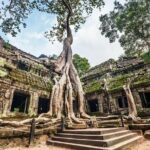
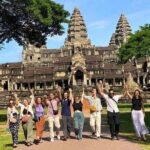
Next come the hill views. Phnom Banan is described as the best-preserved Khmer temple in Battambang Province, with five distinctive towers similar in style to a much larger and more famous temple in Battambang.
You spend about 45 minutes here, which is enough time to climb, orient yourself, and take in the viewpoint without rushing every detail. The payoff is the look over the countryside—Cambodia’s wide open spaces make even short temple climbs feel like more than a quick photo stop.
The key with a place like this: go slow. The temple is small enough that it rewards attention. Look at the towers’ shape and how the site sits within the terrain.
If your energy is high after the early drives, this is a great “top-of-the-day” moment before you transition to caves and more serious stops.
Phnom Sampov and Pkar Slar Cave: Temple Wells and Cave Atmosphere
The tour continues with Phnom Sampov (about 1 hour), a limestone mountain topped with shrines and pagodas. It’s also described as having monkey-inhabited pagodas, and the itinerary notes three natural wells—Pkar Slar, Lo Khuon, and Ak So Pheak.
That matters because Phnom Sampov isn’t only one viewpoint. It’s a cluster of religious points and natural features, so you’ll feel like you’re moving through a mini-world rather than walking up to a single structure.
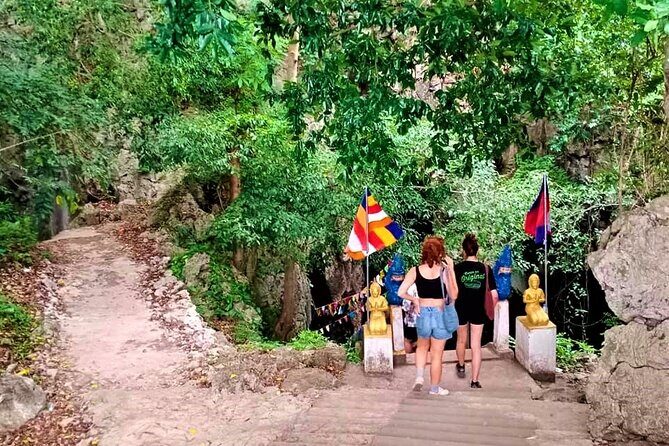
Then comes Pkar Slar Cave (about 1 hour). This cave is described as very small but atmospheric, with a Buddhist shrine inside. Even with its small size, it’s worth treating as a slow stop—small spaces make you notice details more. If you’re picturing a big dramatic cave, adjust expectations. This one is quieter and more shrine-focused.
A practical note: caves and hill temples are cooler sometimes, but you’ll still be sweating most of the day. Carry water and plan for short transitions, not long stuck-in-the-sun breaks.
The Killing Cave Stop at Phnom Sampeau: When the Day Turns Heavy
Then the itinerary shifts tone. The Killing Cave (about 1 hour) is on Phnom Sampeau, described as a Khmer Rouge execution site. The tour frames it as a tragic reminder of the Khmer Rouge era, with victims killed on top of the cave.
This is not the kind of stop you do on autopilot. If you feel uncomfortable with heavy historical sites, it can still be worth including—but you should go with your expectations set. Treat it like education and reflection, not sightseeing.
Also, this stop changes how the day feels overall. You’ll likely be more mentally tired afterward, which is why it’s good that the final block includes a less intense, outdoor nature spectacle—bat caves at sunset—so you can decompress.
If you choose to do Phnom Sampeau on this day trip, I suggest taking a breath before you enter. It helps you remember you’re there for understanding, not just photos.
Battambang Bat Caves at Sunset: Why the Timing Matters
The last major natural highlight is the Battambang Bat Caves stop at about 30 minutes, with the focus on sunset. The description is vivid: you’ll see millions of bats pour from the caves and fly into the sky.
Even though it’s short, this is one of those moments where the payoff is massive. What makes it work on a day trip is that the schedule assumes you’ll hit this time window after the more demanding stops.
If you do this part, dress for outdoors time. It can get cooler as the sun drops. And since the stop is brief, be ready to position yourself quickly once you arrive.
This is also a good moment to ask your guide for practical advice about where to stand for the view you want. In experiences tied to this tour, guides were often described as helping with photo opportunities, and bat-cave timing is one of the situations where that kind of guidance actually matters.
Price and What You Actually Get for $166.25
The price is $166.25 per person, with a day-trip duration of about 8 to 10 hours. On paper, that might look steep compared to cheap group buses. In practice, the value comes from what’s bundled:
Included:
- Hotel pickup and drop-off
- Professional English-speaking licensed guide
- All entrance fees for sites listed in the itinerary
- All private transfer by luxury air-con vehicle
- Services charge and government VAT
Not included:
- Lunch (local restaurants, with vegetarian and non-vegetarian options; menu prices are roughly $3–$10 per dish)
- Tips for guide and driver
- Cambodia Peace Gallery ticket (listed at $5.00 per person)
There’s also an optional museum stop: the Cambodia Peace Gallery is open Monday to Saturday and closed on Sunday, and the ticket is not included. If you want that extra layer of context, factor in the $5.
So is $166.25 worth it? For me, the answer depends on what you want out of the day. If you’re happy doing an independent DIY day, you can often cut costs. But if you want a smooth, guided route that handles transport and entry fees, the private format and included admissions can make the price feel fair.
One more practical angle: this itinerary is dense. That’s good for value, but it means you should bring a flexible attitude. If you want a slow two-day pace in Battambang, you’ll likely feel rushed by an 8–10 hour schedule.
What I’d Pack and How to Pace Yourself
No one wants “temple clothing” anxiety on a hill in Battambang. Still, you’ll be walking in heat and climbing a bit on Phnom Banan and Phnom Sampov. Plan for sun and small elevation changes.
I’d pack:
- Comfortable walking shoes with grip
- A hat and sunglasses
- Water (and a small snack for the gaps before lunch)
- A light layer in case the evening bat-cave air feels cooler
Pacing tip: think in blocks. City block first. Bamboo train middle. Hills and caves later. Finish with bats. If you save your energy for the final sunset moment, the heavy Khmer Rouge stop won’t dominate the whole day in your memory.
Who This Tour Suits Best (and Who Might Skip It)
This tour fits you if you want:
- A first-time Battambang day without planning headaches
- A mix of colonial streets, rural travel, temple viewpoints, and caves
- A guide who can support your questions and keep things moving smoothly (people on this tour’s day experiences highlighted guides like Leap, Sara, and Kimy, and drivers like Samart, Lan, Art, and Pheap)
You might consider a different plan if:
- You hate long car days (the overall duration is 8–10 hours)
- You prefer lighter, less reflective content. This itinerary includes the Killing Cave stop, and it’s intentionally heavy.
For many visitors, though, the contrast is the point. Battambang becomes more than a postcard city. It turns into a full emotional story: life, architecture, rural rhythm, then the country’s darker chapters.
Should You Book This Battambang Day Tour?
I’d book this if you want a high-value, private, well-paced day that hits the region’s major experiences in one go—bamboo train, hill temples, caves, and sunset bats—while handling entry fees and transport for you.
I’d hesitate only if a long day plus serious historical sites sounds like too much in one sitting. If that’s you, you may prefer a shorter, temples-and-town-only day, or you may want to split history across multiple days.
If you do book, go in prepared: wear comfortable shoes, plan for lunch on your own, and treat the Killing Cave stop with the respect it demands. Then end the day looking up at the bats. That contrast is exactly why this itinerary works.
FAQ
How long is the Battambang bamboo train and caves day tour?
It runs about 8 to 10 hours.
Do you get hotel pickup and drop-off?
Yes. Pickup and drop-off at your hotel are included.
Is this tour private or shared?
It’s a private tour/activity for your group only.
Is lunch included in the tour price?
No. Lunch is not included, and you’ll eat at local restaurants on your own (vegetarian and non-vegetarian options are available, with menu prices around $3–$10 per dish).
What is included in the tour price ($166.25 per person)?
Entrance fees for the listed sites, a professional licensed English-speaking guide, private air-conditioned transfers, and services charge/VAT are included.
Is the Cambodia Peace Gallery ticket included?
No. The Cambodia Peace Gallery ticket is not included and costs $5.00 per person.
What days is the Cambodia Peace Gallery open?
It’s open Monday to Saturday and closed Sunday.
Are entrance fees included for the temples and caves?
Yes. All entrance fees for the tour sites mentioned in the itinerary are included.
Is there free cancellation?
Yes. You can cancel for a full refund up to 24 hours in advance.
Is the tour suitable for most people?
It says most travelers can participate, and the location is described as near public transportation.