REVIEW · SIEM REAP
Angkor Wat Small Group Tour and Sunset with Lunch Included
Book on Viator →Operated by Asean Angkor Guide · Bookable on Viator
Heat fades; Angkor takes over. This small-group day strings together the big Khmer hits: Angkor Thom (Bayon, Baphuon), Ta Prohm (the Tomb Raider temple), and Angkor Wat—then tops it off with a sunset climb at Phnom Bakheng.
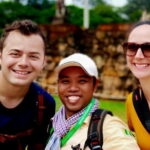
Two things I really like here: the constant comfort help (hotel pickup/drop-off, A/C transport, cold water and wet towels) and the way your guide can set the pace so you’re not just standing there guessing what you’re seeing. You’ll also get a proper day of explanation, with guides such as Seila, Dara, Mony, Phanne, Raman, and Samath praised for clear storytelling and good photo tips.
One consideration: the tour is long (about 10 hours) and you’ll still need to budget for the Angkor Pass separately, plus there’s a sunset climb and a shoulders/knees-covered dress rule.
In This Review
- Key Highlights Worth Your Time
- A Day Built Around the Angkor Big Hits (Not Random Stops)
- Price and What You Really Get for $26
- Pickup, A/C Comfort, and the Dress Code Reality Check
- Angkor Thom South Gate: Your First Moment of “Wow”
- Bayon Temple: The Smiling Faces That Actually Mean Something
- Baphuon and the Terrace of the Elephants: Power, War, and Views
- Ta Prohm: Tomb Raider, Yes. Also, Real Khmer Stone and Roots.
- Lunch at a Local Restaurant, Plus a Palm-Sugar Style Village Stop
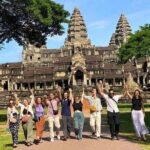
- Angkor Wat in the Afternoon: The Icon, Made Manageable
- Phnom Bakheng Sunset Climb: Classic View, Real Sweat
- Who This Tour Suits Best (And Who Might Want to Skip It)
- Should You Book This Angkor Wat Small-Group Sunset Day?
- FAQ
- What temples are included in this Angkor Wat small-group tour?
- Is hotel pickup and drop-off included?
- Is lunch included, and is there a vegetarian option?
- Are temple entrance fees included?
- How long is the tour?
- What should I wear to visit the temples?
- How large is the group?
Key Highlights Worth Your Time
- Small group size (limited to a smaller number) helps keep the day feeling personal, not cattle-class.
- Cold towels, cold water, and A/C keep you functional in Siem Reap’s heat.
- Big Three temples in one go: Angkor Thom, Ta Prohm, and Angkor Wat.
- Lunch is included at a local restaurant, with a vegetarian option.
- Sunset at Phnom Bakheng gives you a classic viewpoint, even when crowds are thick.
- A guide who adjusts to your level makes the carvings and history easier to read.
A Day Built Around the Angkor Big Hits (Not Random Stops)
This is the kind of Angkor tour that’s designed for people who want the essentials in one day. You’ll cover the main complexes most first-timers target: Angkor Thom (starting at the South Gate/Tonle Om Gate and hitting Bayon and Baphuon), then Ta Prohm, then Angkor Wat, and finally a sunset option at Phnom Bakheng.
What makes that smart for your money is the flow. Angkor can feel overwhelming if you show up with only a map. This itinerary keeps you moving between the most visually important and historically meaningful areas, with a guide to translate the stonework into something you can actually understand.
Also, this day is timed for maximum temple time and minimum “dead transport.” You’ll ride in an air-conditioned vehicle and you’ll get hydration support during breaks between sites, so you don’t feel like your energy evaporates after the first two hours.
If you only have a couple of days in Siem Reap, that matters. A full Angkor circuit can eat up an entire day. Doing it with a built-in route saves you decision fatigue.
A few more Siem Reap tours and experiences worth a look
Price and What You Really Get for $26
At $26 per person, the value is strong—mainly because the big costs are wrapped into the experience: a professional English-speaking guide, driver, A/C transport, lunch, water and towels, hotel pickup/drop-off, and admission tickets to the temples on the schedule.
Two costs you still need to plan around:
- Angkor Pass: it’s explicitly not included and is purchased separately.
- Soft drinks: not included, so plan on water (which you do get) or bring cash for extras.
Here’s how to think about it: the Angkor Pass is the gatekeeper expense, but this tour covers the rest of the “day logistics” that usually drive costs up—guide time, A/C rides, and lunch. For many people, that’s what turns Angkor from a stressful checklist into a day you can enjoy.
And judging by the consistent 5-star feedback, what you’re paying for is more than access. People repeatedly mention the same practical perks: cold towels right after temple stops, drivers who keep the van ready, and guides who make the time feel worth it even if you’ve already been to Angkor once.
Pickup, A/C Comfort, and the Dress Code Reality Check
A private, door-to-door day changes the whole experience. You don’t need to figure out buses, tuk-tuk logistics, or how to get across town at the right time. Hotel/guesthouse pickup and drop-off is included, and you’re asked to wait about 20 minutes in the hotel lobby for pickup.
Inside the vehicle, you should expect real comfort support for the heat:
- Air-conditioning
- Cool bottled water
- Towels (often described as cold/wet for cooling off)
It’s also smart to pack for humidity. The tour info suggests sunscreen, sunglasses, insect repellent, and a camera. I’d add one practical note from the real-world vibe: bring a small personal fan if you run hot. A few reviews specifically call out the heat and the usefulness of extra cooling.
Before you even leave, check the temple dress rules. Shoulders and knees must be covered. You might be able to handle this with light long sleeves and breathable pants, but it’s better to plan than to scramble. At Angkor, rule-following isn’t optional.
Angkor Thom South Gate: Your First Moment of “Wow”
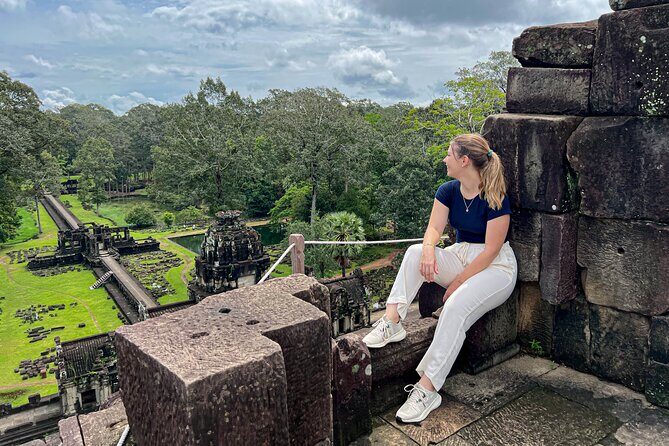
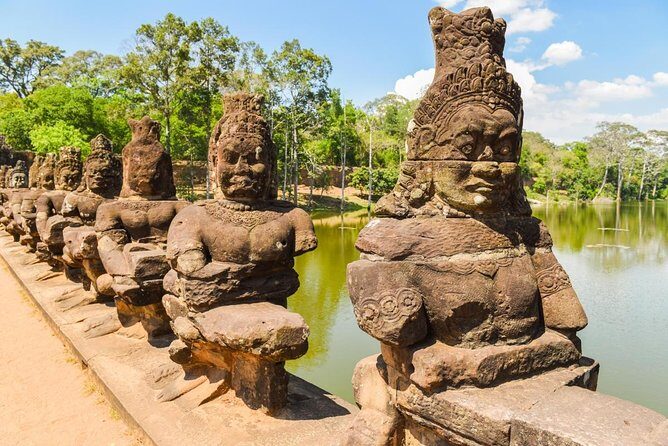
You begin at the South Gate of Angkor Thom (Tonle Om Gate). This is a strong opening because it sets the tone: Angkor Thom feels like a whole world enclosed, not just a single temple complex.
The guide starts you with the big-picture context of the Khmer empire and then brings you into the capital city of Angkor Thom. From a visitor’s perspective, that matters. If you start with Bayon or Angkor Wat first, you often miss the sense of scale that the gates establish.
Time at this stop is about 20 minutes. That’s short on purpose. You’re not meant to linger here all morning—you’re meant to gather your bearings, then move into the main carvings and faces.
Bayon Temple: The Smiling Faces That Actually Mean Something
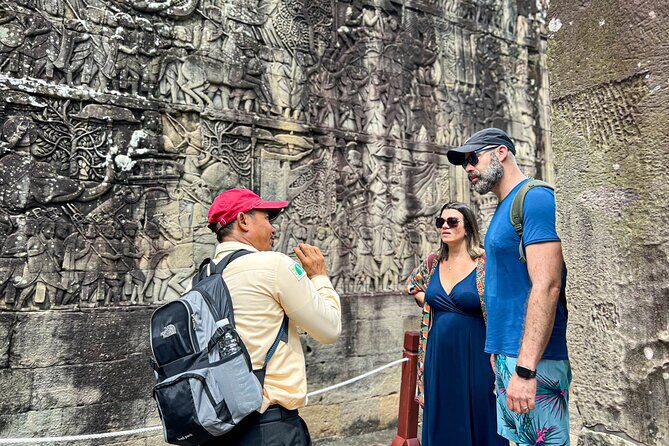
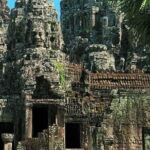
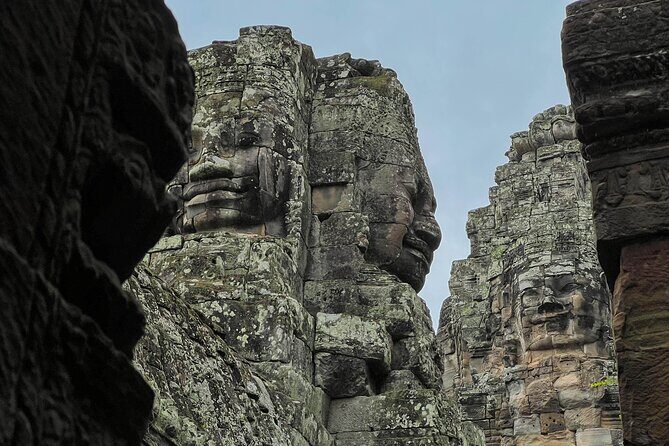
Next up is Bayon Temple, one of the most recognizable places in Angkor Thom. The headline feature is the famous wise and smiling faces, but the bigger value is how a good guide helps you see beyond the iconic look.
Bayon was built in the late 12th century as a state temple of the Mahayana Buddhist tradition. With that background, the carvings stop feeling like decoration and start feeling like messaging.
Expect roughly 45 minutes here, which is a good amount of time. Long enough to walk slowly, take photos from the angles that flatter the towers, and still ask questions without feeling rushed. If you’re the type who likes architecture details, this is where the guide’s explanations tend to shine—reviews repeatedly praise guides for reading the carvings and explaining what you’re looking at.
You can also read our reviews of more evening experiences in Siem Reap

Baphuon and the Terrace of the Elephants: Power, War, and Views
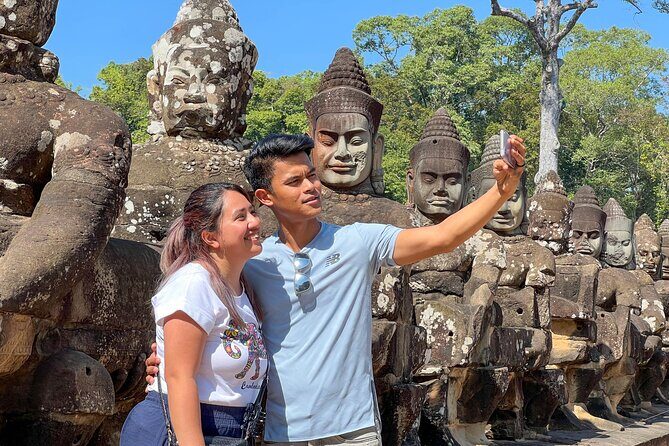
After Bayon, you’ll hit Baphuon Temple. This is the three-tier temple mountain, and it’s tied to Shiva. The stop is shorter—about 30 minutes—but it’s enough time to understand the vertical idea: it’s designed to pull your eye upward as a metaphor for rank, divinity, and reach.
Then comes the Terrace of the Elephants, which sits within the walled area of Angkor Thom. This terrace is connected to King Jayavarman VII, and it’s described as a platform from which he could view his army returning from victorious campaigns.
This stop is brief—about 15 minutes—but it’s visually worth it because it helps you connect the dots between religion and state power. It’s not only temples in isolation; it’s temples inside a political landscape.
Ta Prohm: Tomb Raider, Yes. Also, Real Khmer Stone and Roots.
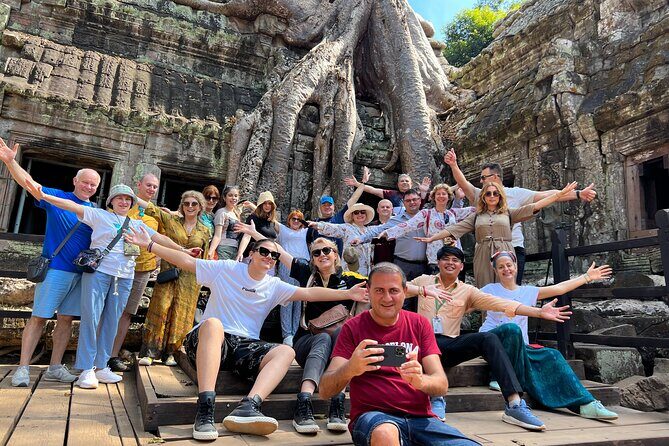
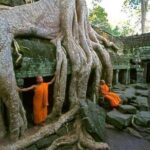
Ta Prohm is the “Tomb Raider” temple stop. It’s famous because the ruins have been left in a near-natural state—partly overgrown with huge trees and roots. The film association is real (the temple was used as a backdrop for Tomb Raider starring Angelina Jolie), but what matters on your day is that the visuals are more than a movie set.
You’re given about 1 hour at Ta Prohm. That’s enough time to enjoy:
- the dramatic root systems,
- the way the stone frames the forest,
- and the feel of walking among carvings that still look alive.
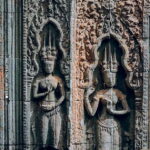
The best part, if you care about authenticity, is that a guide can point out the engineering logic behind the layout and explain why this temple still looks the way it does. It’s easy to see Ta Prohm as just “cool photos.” With the right guide, you’ll read it as a living archaeological story.
Lunch at a Local Restaurant, Plus a Palm-Sugar Style Village Stop
After Ta Prohm, you’ll take a lunch break at a local restaurant cooked by a local chief, with a vegetarian option. Lunch is about 1 hour, and this is one of the most practical inclusions on the whole day.
Why? Angkor days can turn into a snack-only ordeal. Having a scheduled meal prevents the classic problem: you get hungry right when the best light and best temple flow hit. Here, lunch is placed so you can recharge before the heavier Angkor Wat portion later.
Then you’ll visit a village stop described as Phum Preah Dak, where you learn how locals make palm cake and palm sugar. This adds a different kind of meaning to the day. You’re not only consuming monuments. You’re seeing how people make and process everyday products that tie to the region’s rhythms.
Some reviews mention similar village-style food stops (like coconut rice cakes). The takeaway for you is simple: expect a short cultural detour, not a performance.
If you’re short on patience for stops that aren’t temples, this is still likely worth it because it gives a break from heat and stone and gives your brain something else to hold onto.
Angkor Wat in the Afternoon: The Icon, Made Manageable
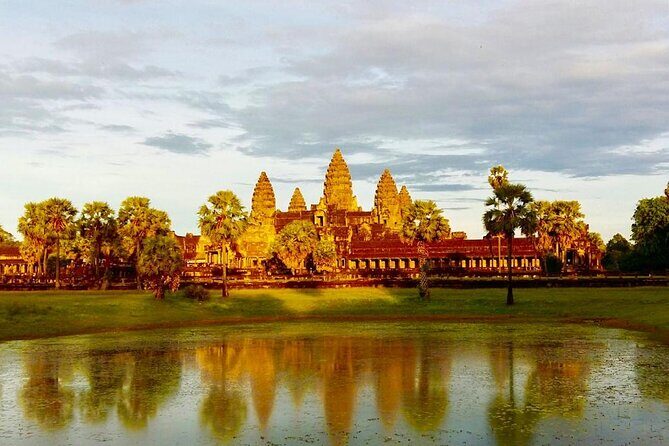
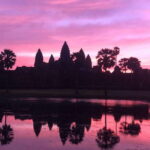
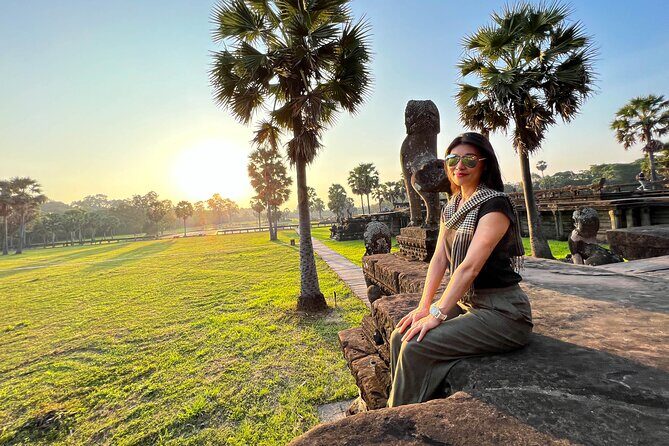
Then you go to Angkor Wat, one of the largest sacred buildings on the planet and an icon of Khmer civilization. It was built by King Suryavarman and dedicated to Vishnu.
Time at Angkor Wat is about 1 hour 30 minutes. That’s a sweet spot. Enough time to feel the scale and walk important sections without burning your whole day. And it’s also the right moment in the day for many people because you’ve already gathered context from earlier stops.
One common mistake at Angkor Wat is treating it like a quick photo sprint. With a guide, you’ll get context: symbolism, architecture intent, and the way the temple’s layout reads as part of a larger cosmology.
Also, timing matters. A few reviews describe guides planning the circuit in ways that reduce crowds, including visiting in reverse order at least once. You can’t count on that every day, but you can count on your guide trying to beat the rush.
Phnom Bakheng Sunset Climb: Classic View, Real Sweat
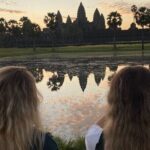
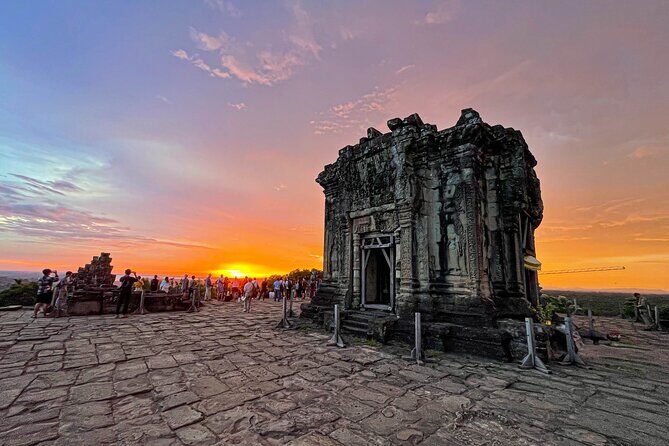
Finally, you climb Phnom Bakheng for sunset. This is the dramatic finish: you’re looking down at the Angkor Wat area from a higher viewpoint.
Plan for it to be physical. Sunset climbs are rarely easy, and this is an open-air hike in heat. The tour supports you with cold water and towels during the day, but you still need to pace yourself on the climb and bring sun protection.
After the sunset time, you’ll be transferred back to your hotel in the center of Siem Reap.
Two practical notes:
- Sunset depends on weather. When weather doesn’t cooperate, the “sunset moment” can be muted, but you can still get strong views.
- Crowds can be heavy at peak viewpoints. Good guidance helps you choose photo angles and timing.
Who This Tour Suits Best (And Who Might Want to Skip It)
This tour is ideal if:
- you want the main Angkor sites in one day,
- you prefer A/C transport and regular cooling breaks,
- you want a guide who explains temple meaning instead of walking past carvings without context,
- you value a small group vibe.
It also works well if you’ve been to Angkor once and want a stronger story the second time. Multiple guides on this tour are praised for making the experience feel new through better explanations and photo help.
You might hesitate if:
- you hate long days (this runs about 10 hours),
- you dislike climbs (Phnom Bakheng sunset includes a climb),
- you’re allergic to rules about covering shoulders/knees (you’ll need to plan clothing).
Should You Book This Angkor Wat Small-Group Sunset Day?
If you’re aiming for maximum value without turning your day into logistics chaos, I think this is a smart pick. The price is low for what’s included: guide, A/C transfers, lunch, and temple admissions, plus cooling support that makes the day survivable.
Book it if:
- you want a structured route across Angkor Thom, Ta Prohm, and Angkor Wat,
- you’ll appreciate a guide who can tailor explanations (and many guides here are specifically praised for clarity and storytelling),
- you want sunset at Phnom Bakheng as a bonus finish.
Skip it only if you’re determined to go fully DIY or you know you can’t handle the heat and the climb. Otherwise, this tour is built for first-timers and time-crunched repeat visitors who want the monuments and the meaning.
FAQ
What temples are included in this Angkor Wat small-group tour?
The tour includes stops at Angkor Thom South Gate, Bayon Temple, Baphuon Temple, the Terrace of the Elephants, Ta Prohm Temple, Angkor Wat, and Phnom Bakheng for sunset.
Is hotel pickup and drop-off included?
Yes. The tour offers pickup and drop-off at downtown hotels or guesthouses.
Is lunch included, and is there a vegetarian option?
Yes. Lunch is included at a local restaurant, and there is a vegetarian option.
Are temple entrance fees included?
Admission tickets for the temples on the schedule are included, but the Angkor Pass is not included and must be purchased separately.
How long is the tour?
The tour lasts about 10 hours.
What should I wear to visit the temples?
You must follow the dress requirement that knees and shoulders must be covered.
How large is the group?
This experience is limited to a smaller group size, with a maximum of 14 travelers, and it’s described as limited to 10 participants to keep it personal.