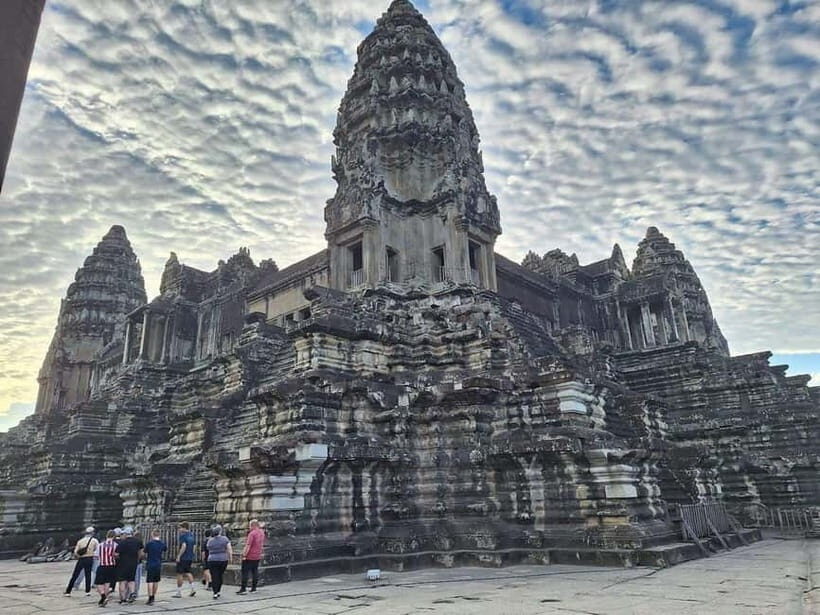
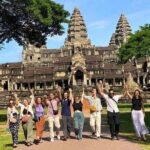
Angkor Wat feels huge, even before you start. What makes this day work is the small-group pace with a professional English guide who helps you understand what you’re seeing instead of just rushing photos.
I like that the tour keeps logistics simple while still giving you real time at the key spots.
I also love the practical comfort details: hotel pickup and drop-off, plus air-conditioned transport with cold towels and bottled water. One possible drawback to plan for: Angkor entrance fees aren’t included (the tour covers the guiding and transport, not the temple ticket).
In This Review
- Key highlights to know before you go
- Price and value: what $50 really buys you
- Pickup, transport, and staying comfortable in the heat
- Stop 1: Angkor Wat orientation and first impressions
- Stop 2: Angkor Thom and the four faces moment
- Stop 3: Ta Prohm jungle temple with real time to wander
- Elephant and Leper King Terraces: the details that round out the day
- Phnom Bakheng sunset: how to make the final view count
- Dress code, temple rules, and how to avoid common mistakes
- Pace, group size, and what the join-in format feels like
- How the guided approach makes a difference at Angkor
- Should you book this Angkor Wat sunset guided join-in tour?
- FAQ
- Are Angkor entrance fees included?
- How long is the Angkor Wat sunset guided tour?
- Is hotel pickup and drop-off included?
- What’s included in the tour price besides the guide?
- What’s the group size?
- What should I wear to the temples?
Key highlights to know before you go
- Max 4 travelers so you’re not stuck in a cattle-line feeling
- Hotel transfers included, which saves time and hassle in Siem Reap
- Air-conditioned transport plus cold towels and bottled water for the heat
- Time at the jungle temple (Ta Prohm), not just quick look-and-go
- Phnom Bakheng sunset window for a classic ending view
Price and value: what $50 really buys you
At $50 per person, this is one of those tours that makes sense if you want a guided Angkor day without turning it into a full-time planning project. The big thing you’re paying for isn’t just the ride and a seat on a bus. It’s someone handling the flow of the day—where you go first, what to notice, and how to make the most of the time you have.
The value gets even better because the group stays small (up to 4). In practice, that means you can ask questions and get answers in the moment instead of waiting your turn. You’re also getting a guide with professional English, plus comfort items that matter in Cambodia’s heat: bottled water and cold towels.
One money item to budget for is the Angkor entrance ticket. This tour doesn’t include that fee. You’ll want to set aside USD 37 for a one-day ticket or USD 62 for a three-day ticket before you go, so you don’t get surprised at check-in.
You can also read our reviews of more guided tours in Siem Reap
Pickup, transport, and staying comfortable in the heat
Your day starts with hotel pickup and drop-off, which is a huge quality-of-life win in Siem Reap. Instead of haggling with drivers or figuring out meeting points, you just show up where they tell you to meet. The tour also uses air-conditioned transport, either a mini-bus or a larger bus depending on the day.
The little details matter. Cold towels and bottled water aren’t fancy, but they help you stay functional when temple walks add up. And because the tour is scheduled as a full day (about 10 hours), you want breaks baked in—this format keeps you moving without making you feel like you’re constantly waiting.
A good sign from the guide-and-driver experience you may encounter: one guide named Sopheap is specifically praised for being informative and having strong English. Another common theme is smooth, clear communication (including WhatsApp) and on-time pickup—both of which make a long day feel manageable.
Stop 1: Angkor Wat orientation and first impressions
Angkor Wat is the big headline, and that’s exactly why this tour starts here. You’ll get into the main area and focus on the parts that help you understand the layout—especially useful if you’re visiting for the first time.
Time is short at this first stop (listed at around 2 minutes), so don’t expect a long sit-down there. Instead, think of it as a guided launch: you’ll see Angkor Wat early in the day, get context, and then move on while the rest of the complex is still unfolding.
Also, entrance is not included for this stop. If you haven’t sorted your ticket ahead of time, it’s the one moment where you’ll want to be ready. Wear the right clothes and keep your shoes comfortable—Angkor walking adds up fast, even if the stops don’t look long on paper.
Practical tip: because you’re starting with the main temple, ask your guide what to look for in the carvings and layout. A minute of orientation can make the rest of the day feel clearer.
Stop 2: Angkor Thom and the four faces moment
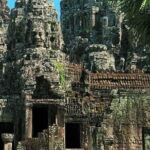
Next comes Angkor Thom, including the Bayon Temple with its famous four faces. The tour gives this stop about 2 minutes, which again signals a “see it, understand it, then go” pacing.
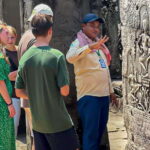
Even if you’re not spending long here, Bayon is one of those places where your viewpoint matters. A guide helps you notice how the faces relate to the broader temple space, and why they’re such an iconic symbol of the Angkor period.
This stop is listed as admission free, which helps your budget. Still, the time you have is brief, so be ready to move. If you’re the type who likes lingering for perfect photos, you’ll want to do your lingering after your guide gives you the key points.
Stop 3: Ta Prohm jungle temple with real time to wander
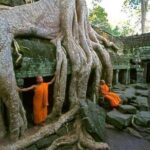
This is the stop where the day shifts gears. You’ll spend about 1 hour at Ta Prohm, and that extra time is the difference between seeing a temple and experiencing why people remember Ta Prohm.
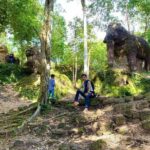
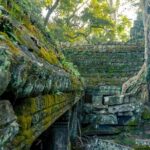
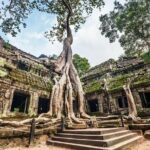
The jungle setting changes everything about how you read the place. You’re looking at stone and structure that feel shaped by growth—roots and plants working their way through the ruins. With an hour here, you can slow down, look around, and actually connect what you’re seeing to the story your guide is sharing.
Also, Ta Prohm is listed as admission free. So in a practical sense, it’s one of the best “value-per-minute” parts of the day: time-heavy, budget-friendly, and visually unforgettable.
One careful note: Ta Prohm can be a little uneven underfoot. Bring shoes you trust. You’ll be walking on paths around ancient surfaces, and you don’t want to rush your steps.
You can also read our reviews of more evening experiences in Siem Reap

Elephant and Leper King Terraces: the details that round out the day
The tour highlights include the Elephant Terraces and Leper King Terraces, which are the kind of stops that make Angkor feel more lived-in rather than just postcard-perfect.
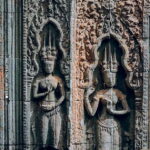
These terrace areas tend to reward slower observation. Carvings and decorative elements can look repetitive if you glance only once, but a guide can point out what each section is, what figures and symbols might mean, and why the terraces were part of ceremonial life.
Because the tour overall is structured as a full-day circuit, you might not get a huge chunk of time here compared with Ta Prohm. But that’s actually a good thing for first-timers: you get the big hits, then the terraces help the day feel complete rather than rushed.
Phnom Bakheng sunset: how to make the final view count
The ending is Phnom Bakheng for sunset, with about 30 minutes at the viewpoint area. Phnom Bakheng is listed as admission free, and that makes the sunset payoff even sweeter.
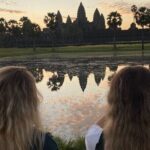
Sunset at Angkor is one of those experiences where the light can change your whole perception of the stone—warm tones, longer shadows, and a view that feels wide and ceremonial. This tour sets you up for that finale after a day of temple walking, so you’re not stuck trying to coordinate sunset on your own.
What to do with your 30 minutes: don’t spend the first half figuring out where to stand. Once you arrive, follow your guide’s lead on the best positioning for views from the temple area. Then settle in and take it in.
And keep your footing in mind. You want to focus on the sky, not on where you’re stepping.
Dress code, temple rules, and how to avoid common mistakes
Angkor temples are religious grounds, so dressing correctly is not just about rules—it’s about respect. The tour asks for smart and casual clothing with shoulders covered, and trousers or knee-length pants or skirts. You’ll also want comfortable walking shoes.
Two rules you should treat as non-negotiable:
- Do not climb on the ancient monuments
- Respect the religious grounds
That’s also how you avoid getting pulled aside by staff. And honestly, you’ll enjoy the temples more when you’re standing on stable ground, looking in the right direction, not craning or scrambling.
Weather can be unpredictable, and the tour operates in all weather conditions. So bring what you need for the day you get—waterproof layers if rain happens, or breathable clothing if it stays hot.
Pace, group size, and what the join-in format feels like
This is a join-in tour, but not a giant-group one. The maximum size is 4 travelers, which changes the whole feel. With a small group, you get more personal attention and flexibility for where you spend your time around each stop.
One review note that lines up with this style: the guide can orient based on your individual wishes, and the driver and guide tend to show up on time. That matters because a long day with a tight schedule is only enjoyable if you’re not constantly waiting.
Walking is part of the deal. Some stops are brief, some are longer (especially Ta Prohm), but you’re still moving through an enormous site. If you’re expecting a totally light stroll with minimal steps, you might find it more active than you planned.
This tour is also listed as not suitable for children under 3 years old. If you’re traveling with kids older than that, you’ll still want to be realistic about standing, heat, and time on foot.
How the guided approach makes a difference at Angkor
A big reason I like guided temple tours is that they help you see beyond the obvious. Angkor Wat and Bayon are famous, sure. But the rest of the complex becomes way more interesting when someone gives you context about layout and meaning.
What you’ll likely get from your guide:
- quick orientation at the start so the complex makes sense later
- explanation at each key temple so the details don’t feel random
- practical guidance on where to focus so you don’t waste your limited time
The best guides also manage the day so you’re not stuck in one spot too long. That’s important here because some stops are short. You’re not touring for hours at one place. You’re collecting the main temples, then finishing with sunset in a planned window.
If you want Angkor to feel like more than “I saw the famous pictures,” this guided format is the right kind of structure.
Should you book this Angkor Wat sunset guided join-in tour?
I think you should book if:
- you want a guided Angkor day without handling logistics on your own
- you like a small-group size (up to 4) instead of a crowded bus feel
- you want a sunset finish at Phnom Bakheng without having to plan it separately
- you’re happy to budget for the Angkor entrance ticket separately
I’d pause or look elsewhere if you:
- expect entrance fees to be included in the price
- want long, independent free time at each monument with no guidance
- are looking for an ultra-low-walking experience
If you’re a first-timer, or you just don’t want the stress of planning, this tour is a solid value. The mix of temple highlights, guided context, air-conditioned comfort, and a sunset payoff at Phnom Bakheng makes it a practical way to see a lot while staying sane.
FAQ
Are Angkor entrance fees included?
No. Angkor entrance tickets are not included in the tour price. A one-day ticket is listed as USD 37 and a three-day ticket as USD 62.
How long is the Angkor Wat sunset guided tour?
The tour runs about 10 hours (approx.).
Is hotel pickup and drop-off included?
Yes. The tour includes hotel pickup and drop-off.
What’s included in the tour price besides the guide?
You get transport in air-conditioned vehicles, a professional English-speaking guide, cold towels, bottled water, and a full-day guided visit covering Angkor Wat, Bayon, and Ta Prohm (plus the sunset experience).
What’s the group size?
The maximum group size is 4 travelers.
What should I wear to the temples?
Dress smart and casual, with shoulders covered. Wear trousers or knee-length pants or skirts, and bring comfortable walking shoes. Do not climb on the ancient monuments.