REVIEW · SIEM REAP
Angkor Wat, Ta Promh, Banteay Srei, Bayon temples Private Tour
Book on Viator →Operated by About Cambodia Travel & Tours · Bookable on Viator
Five temples, one Khmer empire story. This private guided circuit strings together Cambodia’s most famous Angkor sites in a way that’s easy to follow, with an English-speaking licensed guide giving context as you go. I like how the route covers both the postcard classics and the more delicate, less-copied craftsmanship that makes Khmer temple art feel personal.
The second thing I really like is the comfort level: you get private air-conditioned transfers, plus cold drinking water and cold towels during the day. One possible drawback to plan for is cost creep: entrance is not included, so you’ll need the Angkor Pass (and you should budget for tips too).
In This Review
- Key highlights worth your time
- Why this Angkor circuit works so well for first-timers
- Price and value: what the $65.55 covers, and what it doesn’t
- Getting around: pickup, comfort, and how the day stays readable
- Angkor Wat: symmetry, scale, and why it hits first
- Ta Prohm: the jungle temple effect without the chaos
- Banteay Srei: the pink sandstone temple that feels delicate
- Pre Rup sunset: short time, big payoff
- Victory Gate and Bayon: the Angkor Thom faces
- Angkor Thom: “big capital” in a short stop
- The guide factor: why this tour gets such strong praise
- Lunch, water, and small practical tips for a smoother day
- Should you book the Angkor Wat, Ta Prohm, Banteay Srei, Bayon temples private tour?
- FAQ
- Is hotel pickup and drop-off included?
- How long is the tour?
- Are temple entrance fees included?
- Does the tour include a guide?
- Is transportation included?
- Is lunch included?
- Is this tour private?
- Can I cancel for a full refund?
Key highlights worth your time
- Private, only-your-group pacing across the Angkor Archaeological Park highlights
- Angkor Wat’s massive scale and bas-reliefs with enough time to take it in
- Ta Prohm’s jungle entanglement left largely untouched, with a visitor path carved in
- Banteay Srei’s pink sandstone precision, including carvings and Shiva-themed details
- Pre Rup sunset to close the day with a calmer, golden-hour feel
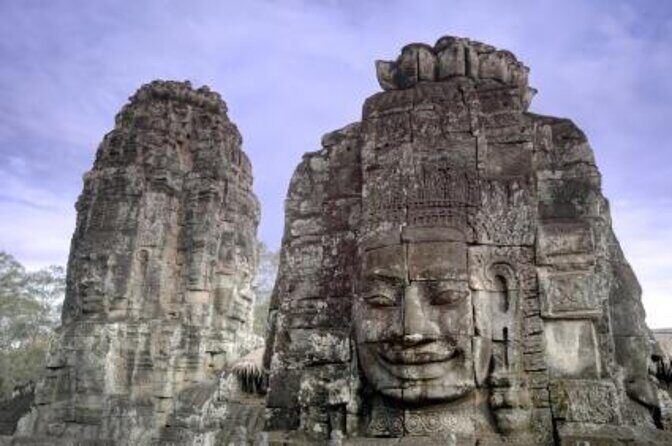
- Bayon’s face towers and Jayavarman VII context explained clearly by your guide
Why this Angkor circuit works so well for first-timers
Angkor can feel like a blur of stone at first. This tour helps you avoid that by keeping the day structured around a logical sequence of the most recognizable stops. You start with Angkor Wat, move into Ta Prohm, head to Banteay Srei, and then finish with the Angkor Thom area including Victory Gate and Bayon.
I like that you’re not just being shown monuments. With a licensed guide, you get help reading what you’re looking at: symmetry at Angkor Wat, the “nature meets stone” vibe at Ta Prohm, and the symbolism behind Bayon’s face towers. That kind of context turns a photo-op into an actual story you can keep in your head.
And since it’s private, you get a little more control over your pace. You’re still following a set route, but you’re not stuck waiting behind a long line of unrelated groups while your feet burn through your socks.
You can also read our reviews of more private tours in Siem Reap
Price and value: what the $65.55 covers, and what it doesn’t
At $65.55 per person, this is priced as a full-day guided temple experience with pickup and drop-off from your hotel, plus private air-conditioned transport. It also includes cold water and cold towels, and it covers service charge and current government VAT tax.
What’s not included is important for budgeting. Entrance fees require an Angkor Pass, and those temple admissions for the itinerary aren’t bundled in the price. Your guide assists you with buying the pass at the entrance of Angkor Park before you start.
Lunch is also on your own. There are local restaurant options with vegetarian and non-vegetarian meals, and prices are roughly $3–$10 per dish. You’ll likely spend more time than you expect eating between temple legs if you’re not prepared, so I recommend planning to grab something quick and avoid letting meals turn into a full schedule reset.
Finally, don’t forget tips for the guide and driver. The tour is good value, but the day’s real cost is the combination of the tour price plus entrance and food.
Getting around: pickup, comfort, and how the day stays readable
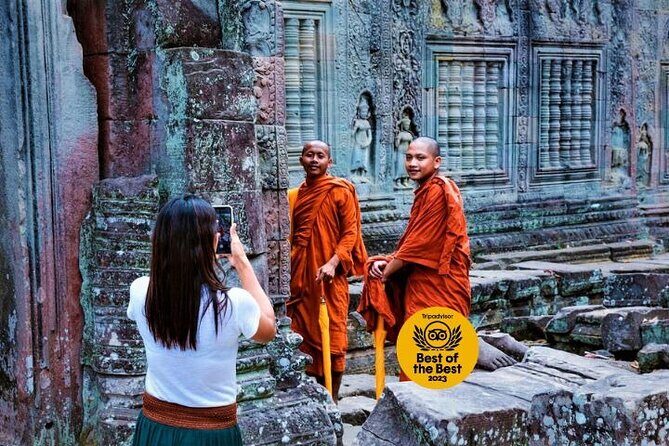
This is built as a “knock out the highlights” day, and the logistics support that. You get pickup & drop-off at your hotel, then ride in a private air-conditioned vehicle between stops.
The comfort details matter more than you think at Angkor. Cold water and cold towels are included, which helps you keep moving when the heat ramps up. When you only have 40 minutes here and 30 minutes there, small comfort boosts can mean the difference between rushing through carvings and actually pausing long enough to understand them.
Also, the tour uses a mobile ticket for the experience. That’s handy in Siem Reap, where you’ll otherwise be dealing with paper confirmations and multiple tickets if you booked a few activities.
Angkor Wat: symmetry, scale, and why it hits first
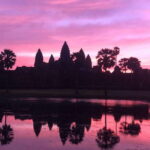
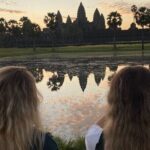
Angkor Wat is the natural starting point because it sets the tone for everything else. You get about 2 hours at this enormous temple complex, originally built in the first half of the 12th century as a Hindu temple, and today visited as a major religious site.
What I love about Angkor Wat is how the layout teaches you how Khmer architects thought. The perfectly symmetrical design and massive scale can feel almost unreal when you’re standing inside it. And the bas-reliefs are a big part of why it’s more than a single landmark. They turn the walls into a kind of stone canvas, with scenes carved for viewers who took time to look closely.
The potential tradeoff is time density. Two hours sounds like plenty until you factor in walking, photos, and your guide pointing out key carvings. If you’re the type who could spend half a day here alone, you may feel the pace is still quick. The good news: this itinerary is balanced, and Angkor Wat is only the first chapter.
Ta Prohm: the jungle temple effect without the chaos
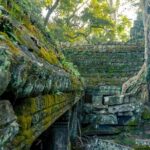
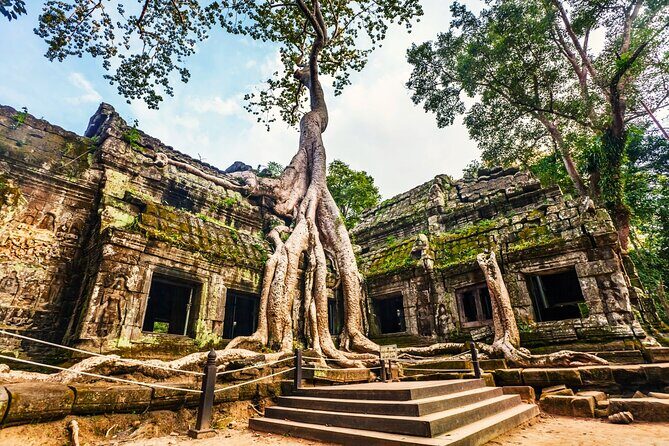
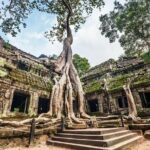
Next comes Ta Prohm (about 1 hour 30 minutes). This is the temple people usually recognize from photos, but the special factor is why it looks that way. Ta Prohm is described as the kingdom of the trees, and the site has been left largely untouched by archaeologists, except for clearing visitor paths and structural strengthening to prevent further deterioration.
That combination is what makes it feel haunting rather than staged. Instead of a fully restored temple look, you see the ongoing relationship between stone and roots, and it gives you a stronger sense of how time reshapes monuments.
One consideration: you’ll probably want to pause often. Ta Prohm invites lingering because the visuals keep changing depending on where you stand. If you prefer a strict, no-pause sightseeing style, you might find this stop runs “long in your mind” even if the clock says 90 minutes.
Still, this is a great stop for anyone who wants the Angkor experience to feel cinematic, not just architectural.
Banteay Srei: the pink sandstone temple that feels delicate
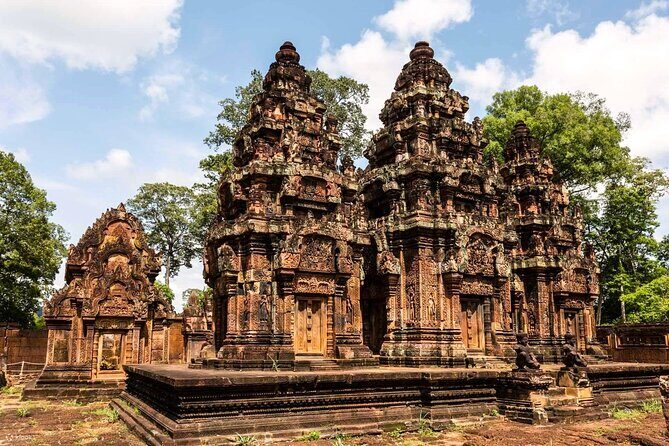
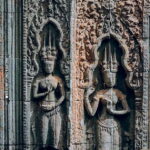
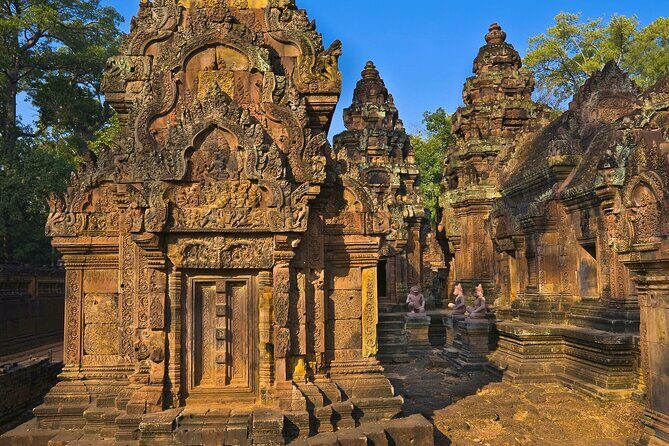
Banteay Srei gets 1 hour in this itinerary, and it’s an excellent use of that slot because it’s the kind of place where details matter. It’s a 10th-century Cambodian temple dedicated to Shiva, and the most memorable part is the fine pink sandstone carvings.
If Angkor Wat feels monumental, Banteay Srei feels precise. You notice how the carvings, lintels, and friezes are built for close looking, not just distant admiring. This temple is also celebrated as the Citadel of Women, which is a fun way to remember that it’s not simply about scale. It’s about craftsmanship.
The main drawback is that “one hour” can go fast if your guide is pointing out multiple carved elements. If you like to take your time, I suggest you pay attention to what your guide emphasizes, because they’re usually choosing the carvings that are most distinctive.
For many people, this is the stop that breaks the day into something more intimate.
Pre Rup sunset: short time, big payoff
After Banteay Srei, you end with Pre Rup (about 40 minutes). The highlight here is sunset. Pre Rup is often one of those finishing viewpoints that helps you step back from the constant close-up detail and see the wider temple landscape in softer light.
I like closing with Pre Rup because it changes your brain mode. During the earlier stops, you’re focused on bas-reliefs, carvings, and structure. At sunset, you’re balancing interpretation with atmosphere. Even if you’re not a sunset fanatic, this timing gives the day a natural rhythm instead of ending abruptly after Bayon.
The consideration is simple: 40 minutes is not a long hangout. If you want to sit quietly for a long time, you may feel a little time-pressured. But as a payoff, it’s one of the best uses of the itinerary’s limited afternoon window.
Victory Gate and Bayon: the Angkor Thom faces
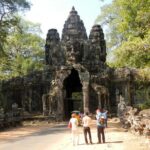
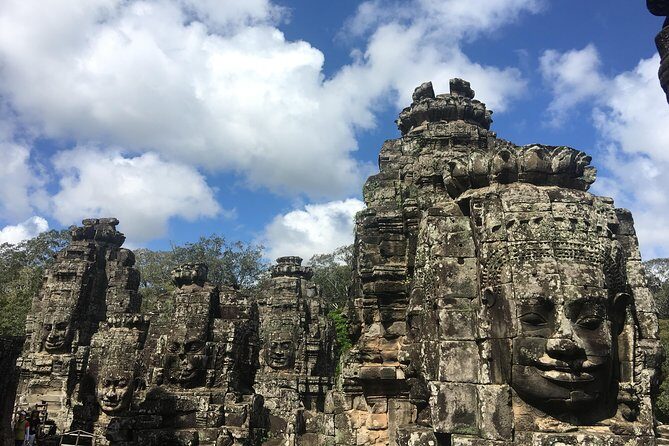
Then you move into Angkor Thom’s ruins. The tour includes the Victory Gate first (about 30 minutes). This is one of the most famous gates at the Angkor Thom complex, and it works as a quick “threshold moment.” Gates matter at Angkor because they signal transitions, and Victory Gate helps you connect the later stops to the larger idea of the Khmer capital.
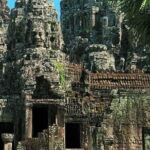
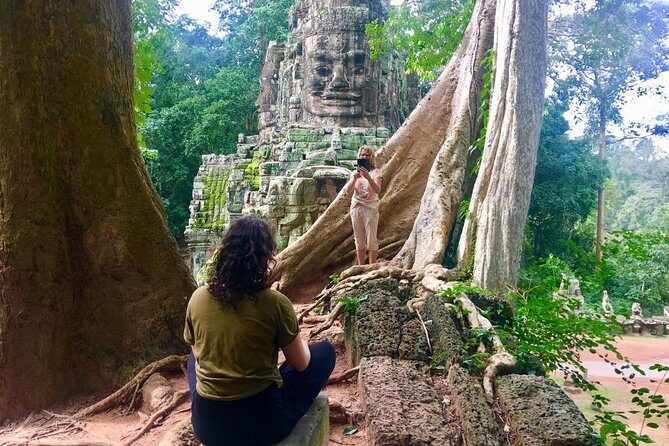
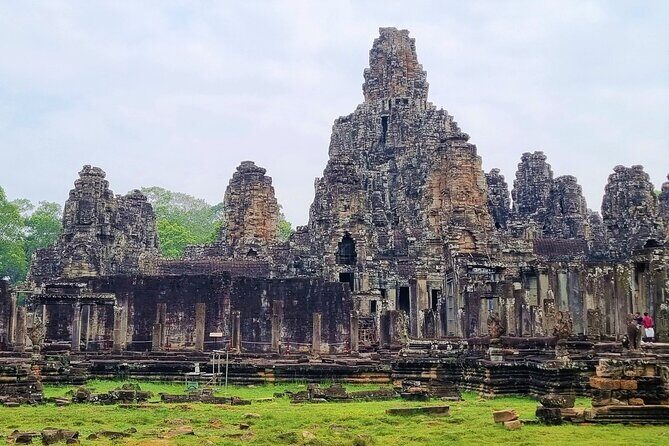
After that, you get 2 hours at Bayon Temple, one of the most distinctive sites in all of Angkor. Bayon was constructed during Jayavarman VII’s reign, and it’s unique in this region as a Buddhist state temple and described as the last to be built in the Angkor Empire. The signature feature is the face towers: repeated stone faces that look out from multiple directions.
Here’s where a great guide can make your visit feel personal. The guide isn’t just naming features; they help you understand why those faces are everywhere and what they mean in the context of the city and empire.
If there’s a drawback, it’s that Bayon can feel visually busy. Between faces, angles, and carved details, it’s easy to keep walking without really taking in how the temple is arranged. Make a point of slowing down at least a couple of moments and let your guide direct your attention to the most meaningful viewpoints.
Angkor Thom: “big capital” in a short stop
Finally, you get a brief look at Angkor Thom itself (about 30 minutes). The name Angkor Thom, sometimes spelled Angkor Tom, is explained as being used after Angkor stopped being the capital. It means Angkor Big or Capital Great.
Even in a short stop, that context helps. Angkor Thom isn’t just another temple cluster. It’s the city-level setting for the politics, religion, and artistic ambition of the Khmer Empire.
The time is short, so you’ll want to let your guide decide what to highlight most. If you’re the type who likes to roam and discover on your own, this end stop may feel like it’s over quickly. But that’s also why this itinerary works for so many people: it prioritizes key points without losing the meaning behind them.
The guide factor: why this tour gets such strong praise
One reason this tour earns top marks is the guide quality. In the feedback for this experience, Mr. Lorn Leap stands out for being patient and very knowledgeable, and for pointing out the carvings and statues you’d miss if you only followed your own eyes. He also focuses on teaching about the Khmer people, not just stone buildings.
That approach matters because Angkor isn’t self-explanatory. If you’ve ever felt like you’re staring at a wall and wondering why you should care, this is the fix. A strong guide helps you connect patterns in the architecture to how the Khmer understood power, belief, and storytelling.
It’s also a practical benefit. A guide helps you keep moving efficiently between stops, so you’re not spending the day trying to figure out where to go next.
Lunch, water, and small practical tips for a smoother day
Because lunch isn’t included, you’ll want a plan. During the tour, lunches are available at local restaurants with both vegetarian and non-vegetarian options, typically $3–$10 per dish. I’d treat lunch like a reset, not a second full tour. Order something simple, eat, and get back to the temples with less stress.
Water and towels are handled for you, which is a relief. Beyond that, you’ll still want to be ready for temple walking. Comfortable shoes matter more than fashion, and having your personal essentials (like sun protection) makes you feel less drained.
Also, keep an eye on entrance timing. Since the Angkor Pass is purchased with your guide’s help before you begin, you’ll want to be ready to do that step without delays.
Should you book the Angkor Wat, Ta Prohm, Banteay Srei, Bayon temples private tour?
Book it if you want a structured, high-value Angkor highlights day with an English-speaking licensed guide, private air-conditioned transport, and built-in comfort like cold water and towels. It’s especially worth it if it’s your first time in Angkor and you want the major sites connected into one coherent story instead of separate photo stops.
Skip or reconsider if you already know you want long, slow time in just one or two temples. This itinerary is designed for breadth across several stops, and some locations are only 30 to 40 minutes. Also, if you dislike paying additional fees on the spot, remember the Angkor Pass isn’t included, and you’ll likely add tips and lunch costs to your final total.
FAQ
Is hotel pickup and drop-off included?
Yes. Pickup and drop-off are included from your hotel in Siem Reap, and you provide your hotel name at booking.
How long is the tour?
It runs about 7 to 9 hours.
Are temple entrance fees included?
No. Admission is not included. You’ll need an Angkor Pass, and your guide will assist you with purchasing it at the entrance of Angkor Park.
Does the tour include a guide?
Yes. You’ll have a professional English-speaking licensed tour guide.
Is transportation included?
Yes. All transfers are by private air-conditioned vehicle.
Is lunch included?
No. Lunch isn’t included. Local restaurants offer both vegetarian and non-vegetarian options, and meal prices are roughly $3–$10 per dish.
Is this tour private?
Yes. It’s a private tour/activity, so only your group participates.
Can I cancel for a full refund?
Yes. Free cancellation is available up to 24 hours in advance for a full refund.