REVIEW · SIEM REAP
Sunrise in Angkor and Banteay Srei Private Tour
Book on Viator →Operated by Angkor Buddy Tour · Bookable on Viator
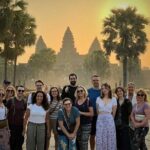
Sunrise in Angkor is worth waking up for. I like the early start (pickup around 4:20–4:40 a.m.) because it puts you inside Angkor Wat while the light is soft, and I love having a professional English guide who explains what you’re seeing and helps with the best photo moments. The only real drawback is the very long day, so plan a serious early night before you go.
This is a private, small-group day with air-conditioned comfort, bottled water, and hotel pickup and drop-off, built around fewer crowds and better viewing conditions. You’ll hit the big names in Angkor, then end with Banteay Srei, the pink-stone temple that feels quieter and more delicate than the main circuits.
In This Review
- Key Highlights You’ll Feel on the Ground
- Price and Logistics: What You’re Really Paying For
- The 4:20–4:40 a.m. Pickup That Changes Everything
- Angkor Wat at Dawn: Floating Bridge, Pond Views, Then Bas-Reliefs
- Breakfast Break: Keep It Simple, Then Keep Moving
- Angkor Thom South Gate: The Most Restored Entrance
- Bayon Temple: Compact Layout, Surprise Views of the Faces
- Ta Prohm: Jungle Temple, Giant Roots, and the Henri Mouhot Connection
- Banteay Srei: Pink Stone, Fine Carving, and a Quieter Finish
- Timing From Start to Finish: When You’ll Land Back in Siem Reap
- Included Extras That Make a Difference Early
- Dress Code, Tickets, and the Drone Rule (Read This Before You Pack)
- Who This Private Sunrise Tour Fits Best
- Should You Book This Sunrise in Angkor and Banteay Srei Private Tour?
- FAQ
- What time is pickup for the Angkor Wat sunrise portion?
- Are temple entrance fees included in the tour price?
- Is breakfast included?
- Is lunch included?
- Are drones allowed at the temples?
- Can I cancel for a full refund?
Key Highlights You’ll Feel on the Ground
- Sunrise timing at Angkor Wat: watch the sky shift before you walk deep into the complex
- A guide who connects stories to stone: expect clear explanations at Angkor Wat, Bayon, and Banteay Srei
- Angkor Thom South Gate first: enter the city side that’s been restored the most and explained well
- Ta Prohm with real jungle drama: the giant root scenery and maze-like interiors take time to enjoy
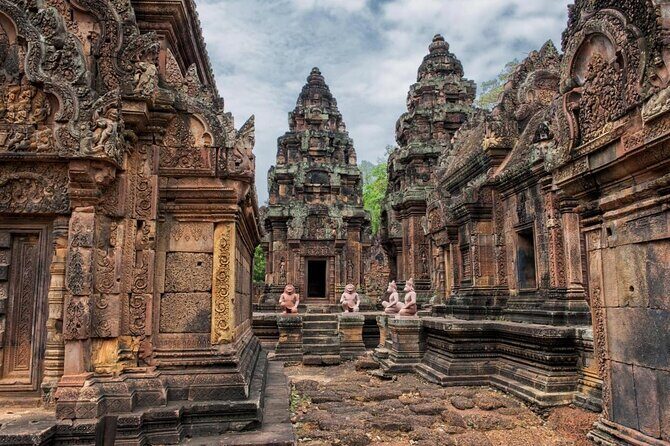
- Banteay Srei’s pink carvings: small temple, very fine sculpture work, far from the main crowds
- Private-group pace: up to 6 people, with hotel pickup and a focused route for the day
Price and Logistics: What You’re Really Paying For
The tour price is $135 per group (up to 6). That matters because you’re not just paying for a driver—you’re paying for an English-speaking guide plus a route that starts when it’s usually chaotic to start. With a full group, your share is low; if it’s only you and one other person, your per-person cost is higher, but the tour stays private.
Temple entrance fees are $37 per person, and those cover temple admission for the included sites. Breakfast and lunch are not included, and neither are tips or travel insurance.
Here’s a practical way to think about total cost (estimate only):
- If you split the group price across 6 people: $135 ÷ 6 ≈ $22.50 each
- Add the temple fee: $22.50 + $37 = about $59.50 per person before meals
If you’re traveling as a duo, the temple fee stays the same, but your share of the tour price rises. Either way, sunrise tours often cost more because you’re paying for early access timing and a guide who’s ready at dawn.
On logistics, the tour does a lot right: hotel pickup/drop-off, air-conditioned vehicle, bottled water, and a mobile ticket. That keeps the early morning from becoming a scavenger hunt for papers and lines.
You can also read our reviews of more private tours in Siem Reap

The 4:20–4:40 a.m. Pickup That Changes Everything
You’ll be picked up between 4:20 and 4:40 a.m., depending on where your hotel is. Getting there early isn’t just about comfort—it’s about the experience.
At this hour, you’re walking into Angkor with:
- cooler temperatures
- fewer people on the main paths
- better chance at calmer photos
- a skyline that’s still building color
If you want sunrise to feel intentional instead of frantic, this timing is the point.
And because it’s a private tour, you can keep a steady pace with fewer stop-and-start moments. The guides who run this well (examples include guides like So and Rei, and others such as Pheap and Tann) tend to stay on schedule without rushing you through the important parts.
Angkor Wat at Dawn: Floating Bridge, Pond Views, Then Bas-Reliefs
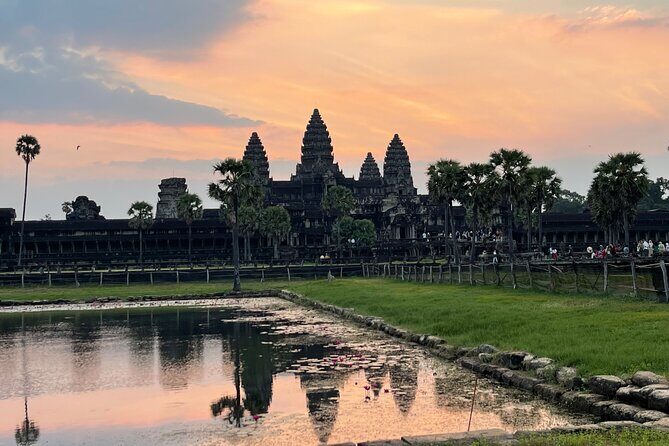
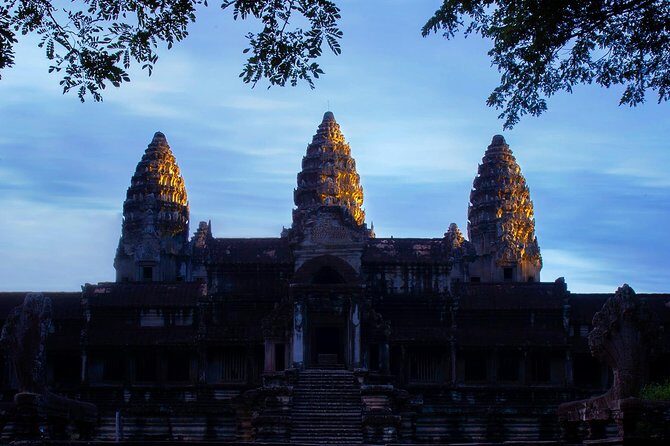
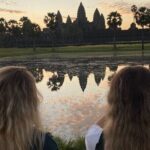
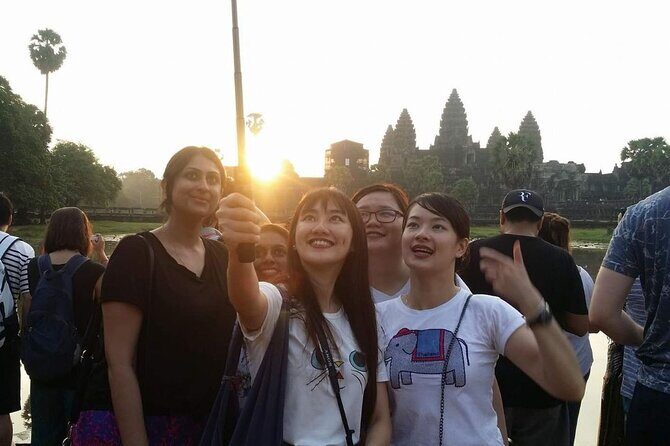
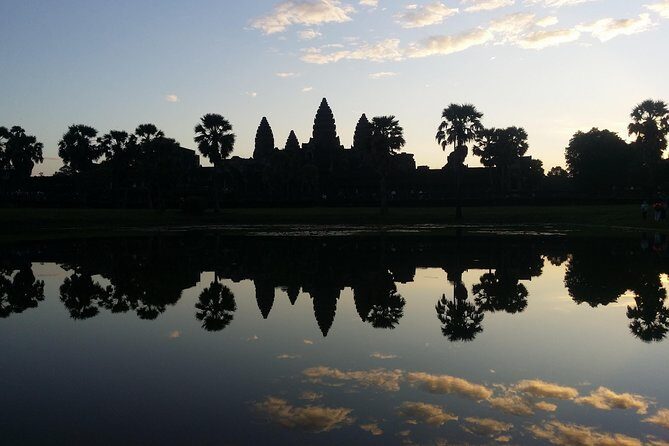
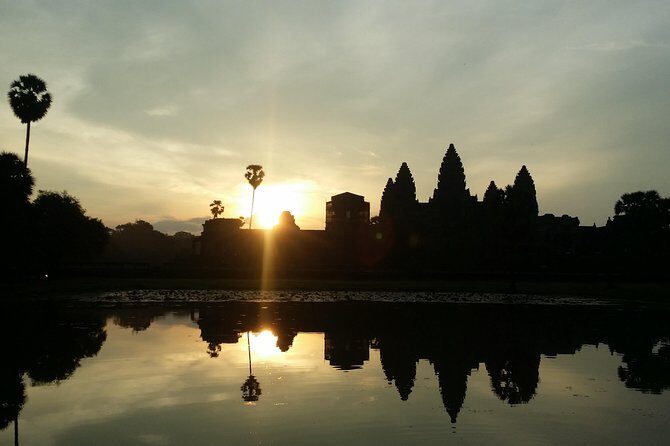
Angkor Wat gets the spotlight for a reason. The most meaningful part of a sunrise visit is often the minutes before the sun crests—when the light is soft and the temple looks almost unreal.
Here’s what to expect in the morning:
- You’ll travel to the ticket office first (about 15 to 30 minutes), then continue to Angkor Wat (another ~15 minutes).
- You cross into the western area by a floating bridge.
- You’re brought toward the pond inside the Angkor Wat complex and given time to stand and watch the sky over the temple before the sun goes up.
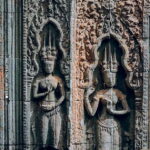
- After sunrise viewing, you spend about two hours exploring key areas of Angkor Wat—statues, bas-reliefs, libraries, and the central tower zones.
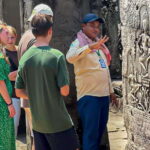
Two hours sounds like plenty until you’re there. Angkor Wat is dense: stone storytelling is everywhere, and a good guide turns random carving into something you can actually follow. You’ll also get photo help during those key moments, because the best angles are usually the ones you don’t think to try yourself at 6 a.m.
If you’re worried about crowds, this route is designed to get you inside before the day swells. That’s where the tour feels “worth it,” not just “nice.”
Breakfast Break: Keep It Simple, Then Keep Moving
After Angkor Wat, you’ll have about 35 to 45 minutes for breakfast. Breakfast isn’t included, but there’s a smart option if your hotel offers breakfast:
- request a breakfast pack and eat after sunrise
That’s a small tip, but it changes the mood. You won’t waste time searching for food, and you won’t end up hungry while the morning itinerary is still building.
Practical advice: bring a little cash for breakfast if you’re not doing a hotel pack, and be ready for early-day food options that are faster than sit-down meals.
Angkor Thom South Gate: The Most Restored Entrance
After Angkor Wat, the tour heads to Angkor Thom South Gate. The south gate is treated as the best-entry option because it’s been extensively restored and is among the most complete of the gates.
You’ll get around 15 minutes of explanation before moving onward. That preface helps, because Angkor Thom can feel like a maze if you show up without context. The south gate also sets the tone: this is where Angkor starts to feel less like a single showpiece and more like a living city layout.
Then you continue to the next stop: Bayon.
A few more Siem Reap tours and experiences worth a look
Bayon Temple: Compact Layout, Surprise Views of the Faces

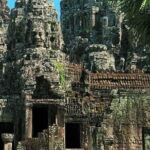
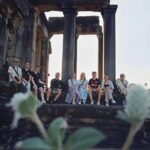
Bayon is one of those temples where the layout makes you slow down. It’s compact, and it doesn’t rely on an outer wall in the same way as some other sites, so it’s easier to step into and move around.
You’ll spend about one hour here, and the guide’s job matters. Bayon’s inner spaces can feel confusing in a good way:
- narrow corridor transitions
- stairways you follow into new angles
- occasional surprise glimpses of the famous faces as you turn corners
The best part is that Bayon rewards attention. If you’re rushing, the faces become just faces. If you have a guide explaining the symbolism and the carving logic, each turn makes more sense, and the experience feels intentional rather than chaotic.
Ta Prohm: Jungle Temple, Giant Roots, and the Henri Mouhot Connection
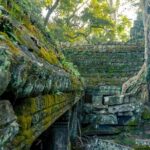
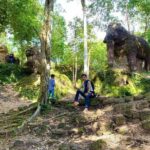
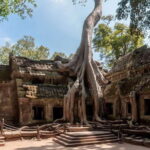
Ta Prohm is where Angkor gets visual drama. This is the jungle-enveloped temple many people picture when they think of wild roots swallowing stone.
The tour builds in time for a rest break and lunch at your own expense, then you move on to explore Ta Prohm—about one hour on-site.
What makes Ta Prohm special in a way you can feel immediately:
- It looks like it’s still being reclaimed by nature.
- It’s associated with an earlier era of discovery. The tour connects the site to French explorer Henri Mouhot and the early 1850s moment when Ta Prohm was rediscovered.
- It’s described as once home to 2,740 monks, which helps you see beyond the “photo scenery” and toward a real place of daily life.
Also, Ta Prohm’s interior has a maze-like feel. That’s why it doesn’t work if you treat it like a quick photo stop. You want a bit of time to turn around, pause, and notice how the roots frame doorways and windows.
One real consideration: because lunch is on your own, plan for a slower midday if you’re choosing where to eat. The itinerary gives you a break; you still choose how long you linger.
Banteay Srei: Pink Stone, Fine Carving, and a Quieter Finish
Banteay Srei is often the best payoff after a big full day. It’s not just another stop—it feels different because of the pinkish stone and the extremely detailed sculpture work.
This tour visits Banteay Srei for about one hour. Expect:
- a Hindu temple dedicated to Shiva
- a start date of 967 CE
- a smaller site scale, but with high “carving density”
- well-preserved, three-dimensional carvings
There’s also a story attached to the name Banteay Srei, meaning Citadel of the Women. The legend says it was built by a woman because the craftsmanship was thought to be too fine for a man. Whether you take the legend literally or just enjoy it as cultural flavor, it frames why the carving looks so delicate.
The “value” angle here is simple: after days of major temple complexes, Banteay Srei gives your eyes something slower. You get to stand close and actually see the depth in the stonework instead of watching the clock.
This is also the late-day moment when fewer people are around compared with the biggest daytime hubs, so your experience can feel calmer without losing the wow factor.
Timing From Start to Finish: When You’ll Land Back in Siem Reap
The tour runs about 9 to 10 hours. After the final temple stop, you return to Siem Reap and drop off at your hotel between 3:30 PM and 4:30 PM, depending on your location.
That timing is useful to know because it protects your evening plans. You’re not stuck out until late night, and you can still enjoy a real dinner and rest after a sunrise start.
But do remember: even though you’re in motion all day, it’s not the “run, run, run” style. The day is structured so you have:
- sunrise viewing time
- a focused set of temples
- breaks at logical moments
Included Extras That Make a Difference Early
A lot of “sunrise tours” can feel like they’re just selling a ticket to get you to the same crowd lines. This one includes practical comfort and support:
- Bottled water
- free hotel pickup and drop-off in Siem Reap
- professional English-speaking guide
- transportation by air-conditioned vehicle
- sightseeing as specified
- mobile ticket
That combination matters on an early start day. It means less uncertainty and less time wasted before your day even begins.
Dress Code, Tickets, and the Drone Rule (Read This Before You Pack)
Angkor is strict about respectful visiting. You’ll need dress with shoulders and knees covered. If you rely on a casual outfit, you’ll likely feel the pressure at the first temple stop—plan ahead.
Temple fees can be purchased on the day of the tour just before sunrise, and the system accepts visa cards. The tour also uses a mobile ticket, which helps reduce paperwork stress.
One more important rule: drone flying isn’t allowed at the temples. If you have a drone anyway, you’ll need to ask permission from APSARA. Since permission isn’t guaranteed based on the information here, the safest move is to leave the drone at home.
Who This Private Sunrise Tour Fits Best
This tour is a good match if you want:
- a sunrise at Angkor Wat without a chaotic scramble
- a guide who explains what you’re seeing (not just where to walk)
- a mix of the big classics plus a quieter, detailed finish at Banteay Srei
- a manageable group size (up to 6) with private routing
It’s less ideal if you hate early mornings, because the pickup starts before most people are awake. It’s also not a fit if you need long sit-down meals built into the day, since breakfast and lunch are at your own expense.
If you’re traveling as a couple, family group, or a small set of friends, privacy gives you space to move at a human pace and to ask questions without waiting your turn.
Should You Book This Sunrise in Angkor and Banteay Srei Private Tour?
If your goal is better light, better timing, and a guided story behind the carvings, this is an easy yes. The route is built around sunrise at Angkor Wat, then smart sequencing through Angkor Thom and Bayon, finishing with Ta Prohm and the pink-stone artistry of Banteay Srei.
I’d book it if:
- you’re comfortable with a very early start
- you want clear guidance and photo help
- you like the idea of a smaller group pace (up to 6)
I’d think twice if:
- you want a late start and a slow breakfast plan
- you don’t want to pay temple fees separately ($37 per person)
One last tip before you decide: because the day includes multiple major sites and one smaller detailed stop, you’ll get the most out of it by saving your energy for looking closely, not just snapping pictures.
FAQ
What time is pickup for the Angkor Wat sunrise portion?
Pickup is scheduled between 4:20 and 4:40 a.m., depending on your hotel’s location.
Are temple entrance fees included in the tour price?
No. Temple entrance fees are $37 per person, and they cover temple admission for the included sites.
Is breakfast included?
Breakfast isn’t included in the tour price. If your hotel includes breakfast, you can request a breakfast pack to eat after sunrise at Angkor Wat.
Is lunch included?
Lunch is not included. You’ll have a lunch break near Ta Prohm where you can buy lunch at your own expense.
Are drones allowed at the temples?
Flying a drone at the temples is not allowed. The info provided says you would need to ask permission from APSARA.
Can I cancel for a full refund?
Yes. Free cancellation is available if you cancel up to 24 hours in advance of the experience start time for a full refund.